ABOUT SKELETONS: MUSEUM OF OSTEOLOGY EXPERIENCE PASSES
The Skeletons: Museum of Osteology Experience Pass can be checked out from any of the Metropolitan libraries and includes a voucher for up to two adults and two children. Each pass can be checked out for 7 days and provides general admission to Skeletons: Museum of Osteology, but they do not provide admission to special exhibits. Passes cannot be renewed and must be returned to the library where they were checked out. Only one pass per household may be checked out at a time. No holds will be permitted on Experience Passes.
HOW IT WORKS
You can check the availability of this Experience Pass here. If you see one is available at your preferred location, please call us at 405-231-8650 or click the live chat button on the right to ask us to verify availability. If a pass is available, we can hold it for you for up to 2 hours.
ABOUT SKELETONS: MUSEUM OF OSTEOLOGY
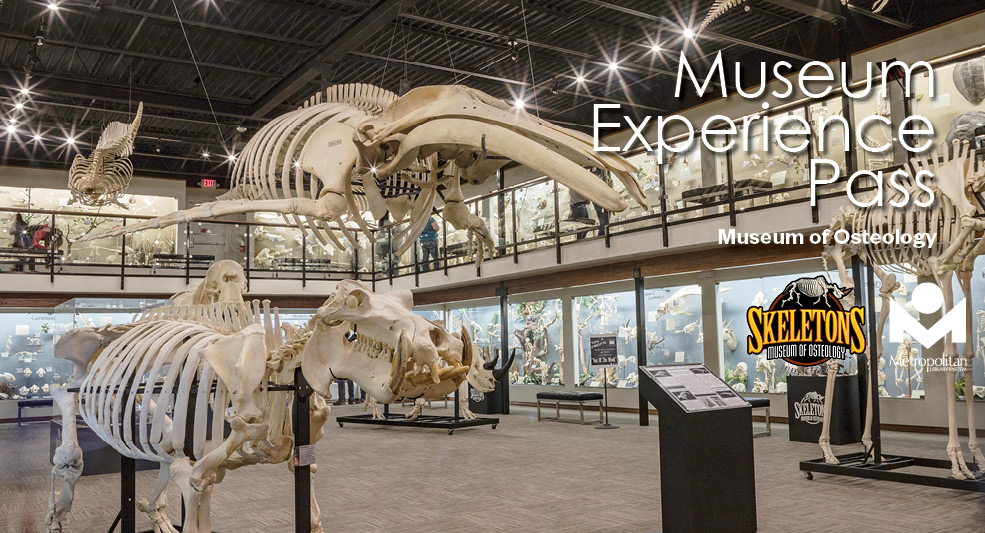
The Skeletons: Museum of Osteology is a 7,000 square foot facility housing over 800 specimens and over 40 exhibits from all corners of the world. Visitors can compare many rare species normally not available in other museum exhibits. The museum features a variety of North American specimens ranging from tiny mice and shrew skeletons to a 40-foot humpback whale.
Get Inspired Before Your Visit
Upcoming Science Events
Join other LEGO fans to engineer some fun! Imagine, create, play, and learn as we build with LEGOs.
Blast off with your imagination at the Ralph Ellison library Lego Club. Lego dreamers of all ages and experience levels welcome.
Disclaimer(s)
The library makes every effort to ensure our programs can be enjoyed by all. If you have any concerns about accessibility or need to request specific accommodations, please contact the library.
Warning: Kit contains small parts that could represent a choking hazard. It is not intended for children under 3. It is encouraged that an adult supervise children while using this Metropolitan Library System Take & Make Bag.
It is encouraged that an adult supervise children while using this Metropolitan Library System Take & Make Kit.
Disclaimer(s)
Be Advised: This program may be photographed and/or videotaped for publicity purposes.
By Attending, you consent: To the use of your voice and likeness in future publicity uses that contain content from this event. If you do not wish to be on camera, please let us know.
For more information visit our Photography & Video Disclaimer
Become a bone detective! In this hands-on class, students will examine real and replica skulls to uncover the secrets they hold.
How did Almonte Library get its name? Why “Almonte”? It’s all thanks to Sylvan Goldman, the inventor of the shopping cart! Born in Oklahoma, Sylvan Goldman owned OKC’s Humpty Dumpty Groce
Are those teeth built for crunching plants, slicing meat, or a bit of both? What do the extra openings on the skull mean?
Full STEAM ahead!!! Come explore in an interactive setting that will challenge your creativity and reasoning through Science,Technology, Engineering, Art, and Math. Each session will present its' own set of challenges. From coding, robotics, building and more...join us and find out what the next challenge may be!
Disclaimer(s)
Be Advised: This program may be photographed and/or videotaped for publicity purposes.
By Attending, you consent: To the use of your voice and likeness in future publicity uses that contain content from this event. If you do not wish to be on camera, please let us know.
For more information visit our Photography & Video Disclaimer
Pepper's Ghost Take Home Kit
Ever wonder how funhouses and classic movies created ghosts or fantastical beings out of thin air? Many were created by the Pepper's Ghost illusion.
Disclaimer(s)
Warning: Kit contains small parts that could represent a choking hazard. It is not intended for children under 3. It is encouraged that an adult supervise children while using this Metropolitan Library System Take & Make Bag.
What can a skull tell us about an animal? In this exciting class, students will explore the five major animal classifications (mammals, birds, reptiles, amphibians, and fish) through the fascinating study of skulls.